
Cold Storage Racking 101: How to Choose the Right Cold Storage Rack System
Article Author: Philip Nelson
Article Contributor: Mike McCue
Cold storage racking requires more than simply choosing a rack type. Because conditioned space is expensive to build and maintain, the storage system must balance density, accessibility, inventory turnover, material handling, as well as account for factors specific to cold storage, such as HVAC systems.
This guide explains the key considerations when selecting racking for a cooler or freezer, including common cold storage rack systems, structural versus roll-formed rack, pallet considerations, and other factors that can affect the design.
What Makes Cold Storage Racking Different?
The main difference between cold storage and ambient storage is the cost of space being used. There are two main considerations:
Consider how the storage system and HVAC system can affect each other.
For cold storage, basic principles of storage system selection such as material handling equipment capabilities, SKU volume, product characteristics, and throughput requirements, are paired with considerations around airflow requirements and refrigeration equipment. The considerations for each should intersect so that the storage system and HVAC system work to maximize the benefits of each other.
For example, the amount and arrangement of racking can change how air moves through a cooler or freezer. A refrigeration system that provides adequate airflow when aisles are partially loaded may perform differently when the storage system is fully loaded and the available air paths become more restricted. Coil placement, rack height, aisle configuration, and the amount of open space around the storage system may all need to be considered to maintain consistent temperature throughout the facility.
Consider the cost of building a given space now versus maintaining it overtime.
For example, a facility deciding between standard and very narrow aisle (VNA) storage may approach the decision differently in a temperature-controlled environment. Although VNA equipment and systems can require a greater upfront investment, reducing the aisle space can reduce the overall footprint that needs to be cooled.
This means that cold storage racking decisions should consider not only the cost of the rack system, but also the long-term cost of maintaining the space in which that system operates.
How to Choose a Cold Storage Racking System
There is no single type of racking that is best for every cooler or freezer. The appropriate system starts with the characteristics of the inventory and how that inventory needs to move through the facility.
Several questions should be answered before selecting a rack system.
How Many SKUs Are Being Stored?
SKU count is one of the most important factors in determining the appropriate storage system.
An operation with a relatively small number of SKUs and high volume per SKU may be able to use a denser storage system. An operation with many SKUs and only a small number of pallets per SKU will generally require greater selectivity.
For example, if a facility has only a few pallets per SKU, a deep-lane pallet flow system may not provide the flexibility the operation needs. Selective pallet rack may be more appropriate because individual pallets need to remain accessible.
How Much Product Is Stored per SKU?
SKU count alone does not tell the whole story. The volume of product associated with each SKU also matters.
A facility with a small number of high-volume SKUs can take advantage of deeper storage lanes because multiple pallets of the same product can be stored together.
A facility with many SKUs but only a half pallet or one pallet per SKU has fewer opportunities to consolidate inventory. In that situation, selectivity becomes more important than maximum density.
Does the Operation Require FIFO or LIFO?
Product turnover requirements can also influence the rack system.
FIFO (first in, first out) storage requirement is often a good fit for pallet flow because pallets can be loaded from one side and retrieved from the other, supporting product rotation while using deep storage lanes.
LIFO (last in, first out) applications may be well suited to push-back racking, particularly when the operation has a relatively small number of SKUs and wants to increase storage density while reducing aisle requirements.
The important consideration is not simply whether a rack system can accommodate FIFO or LIFO. The inventory profile needs to support the way the system operates.
How Frequently Is Product Handled?
Turnover and throughput should also be considered.
If products are frequently moved, a system that requires additional pallet touches may affect labor and equipment requirements. In some applications, however, an additional pallet touch may be an acceptable tradeoff for greater storage density.
The appropriate solution depends on how often inventory moves and what the operation is willing to trade in exchange for additional capacity.
How Much Selectivity Is Actually Needed?
When a facility needs access to individual pallets, the available storage density decreases as selectivity increases.
This is where aisle strategy becomes another consideration. Once a selective storage system is required, the operation may evaluate standard aisles, narrow aisles, or very narrow aisles to determine whether floor space can be reduced without sacrificing the access the operation requires.
What Material Handling Equipment Will Be Used?
The rack system and the material handling equipment should be considered together.
Forklift and reach-truck capabilities can influence aisle width, rack height, and the amount of vertical space that can be utilized. Equipment operating in a cold environment may also have different capabilities or limitations than equipment used in ambient conditions.
Choosing the rack system before determining how the inventory will be stored and retrieved can create unnecessary limitations later.
Cold Storage Racking Options
Once the inventory profile and operating requirements are understood, several types of pallet racking may be appropriate.
Selective Pallet Rack
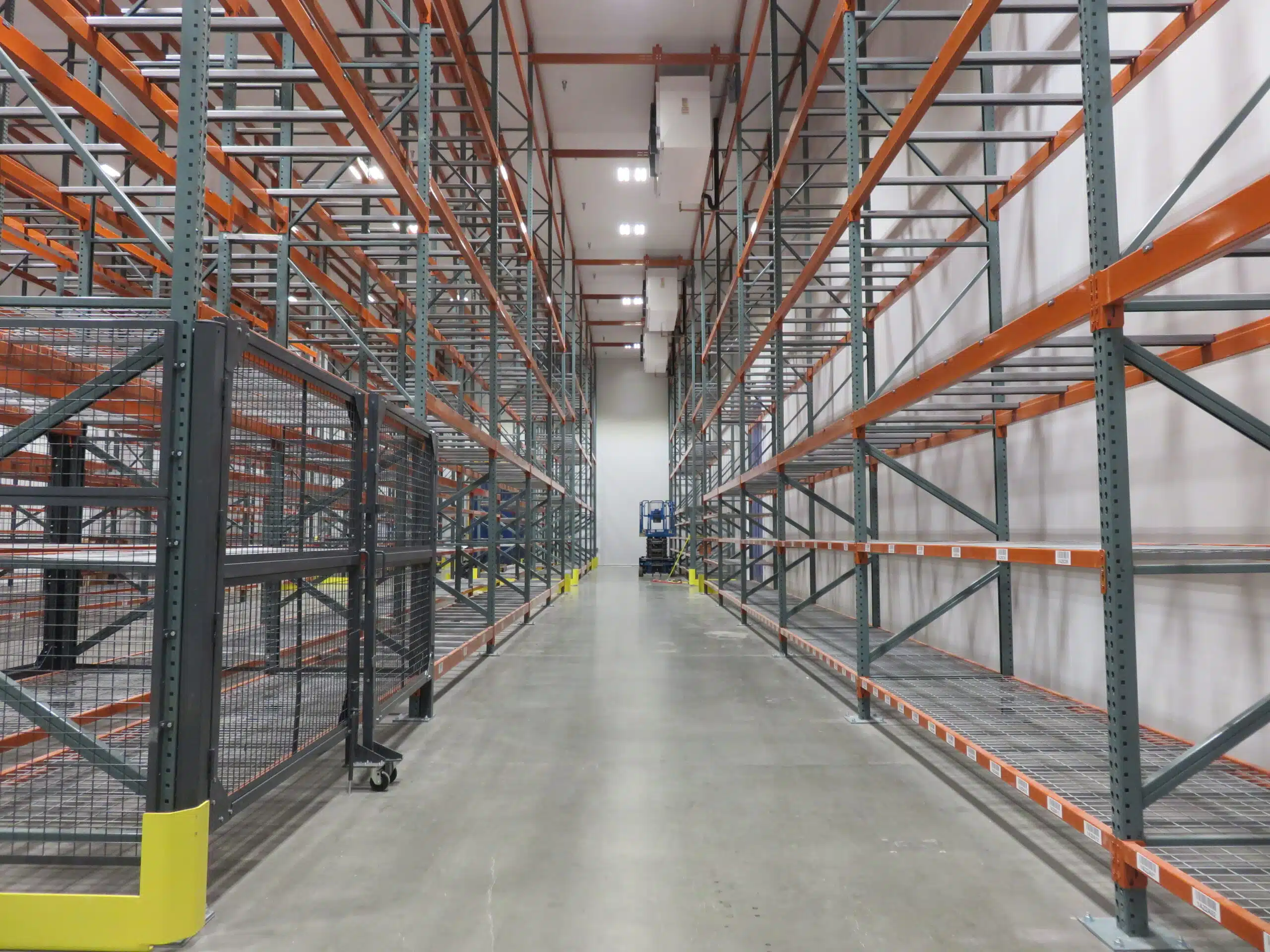
Selective pallet rack provides direct access to individual pallet positions, making it a flexible option for operations with many SKUs or relatively low quantities per SKU.
The tradeoff is density. Because aisles are required for access to individual pallet positions, selective rack generally stores fewer pallets within the same footprint than deeper-density systems.
In cold storage, aisle configuration can become particularly important because reducing aisle space can reduce the amount of conditioned space the facility needs to maintain.
REB worked with a pet supplies retailer to design a rack supported cooler system comprised entirely of selective racking. Read the full case study.
Pallet Flow Rack
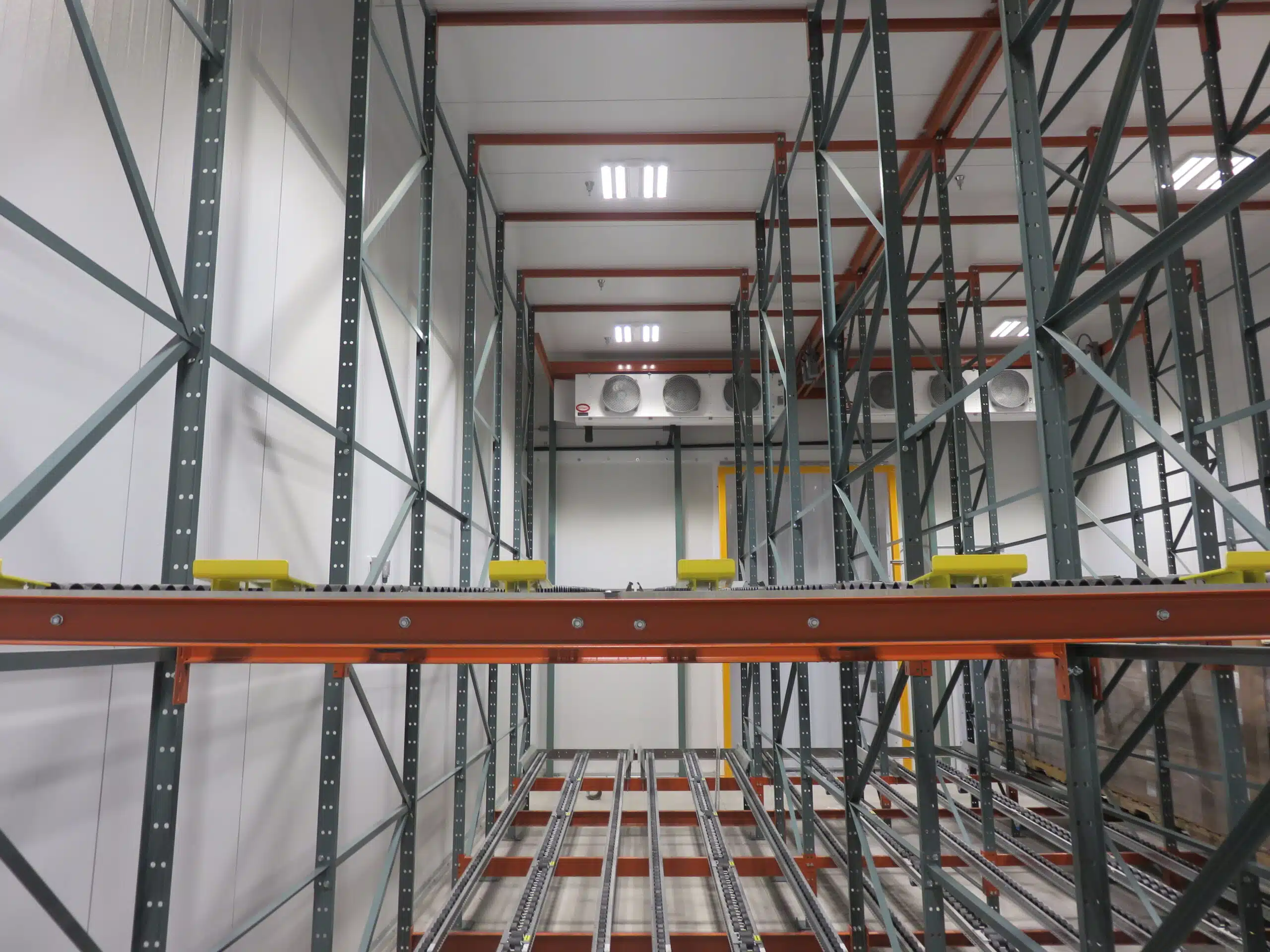
Pallet flow rack uses rollers to allow pallets to move through storage lanes. It can support FIFO inventory rotation while providing greater density than conventional selective rack.
Pallet flow can be particularly useful when an operation has a relatively small number of SKUs with multiple pallets per SKU. Deeper lanes can be used because multiple pallets of the same product can occupy a lane.
The number of pallets that can be stored in a lane needs to be balanced against the inventory profile, throughput requirements, and overall system design.
REB partnered with a vaccine distributor to design and install a rack supported cooler and freezer. The freezer section was entirely comprised of pallet flow racking. Read the full case study.
Push Back Rack
Push back rack is a LIFO storage system that can provide greater density than selective rack by storing pallets multiple positions deep.
It can be useful when an operation has relatively few SKUs but multiple pallets per SKU and does not require FIFO rotation.
Push back can also reduce the number of aisles required compared with selective rack, allowing more of the available footprint to be devoted to storage.
In this case study, learn how a food distributor used push back for their cold storage warehouse.

Drive-In Rack
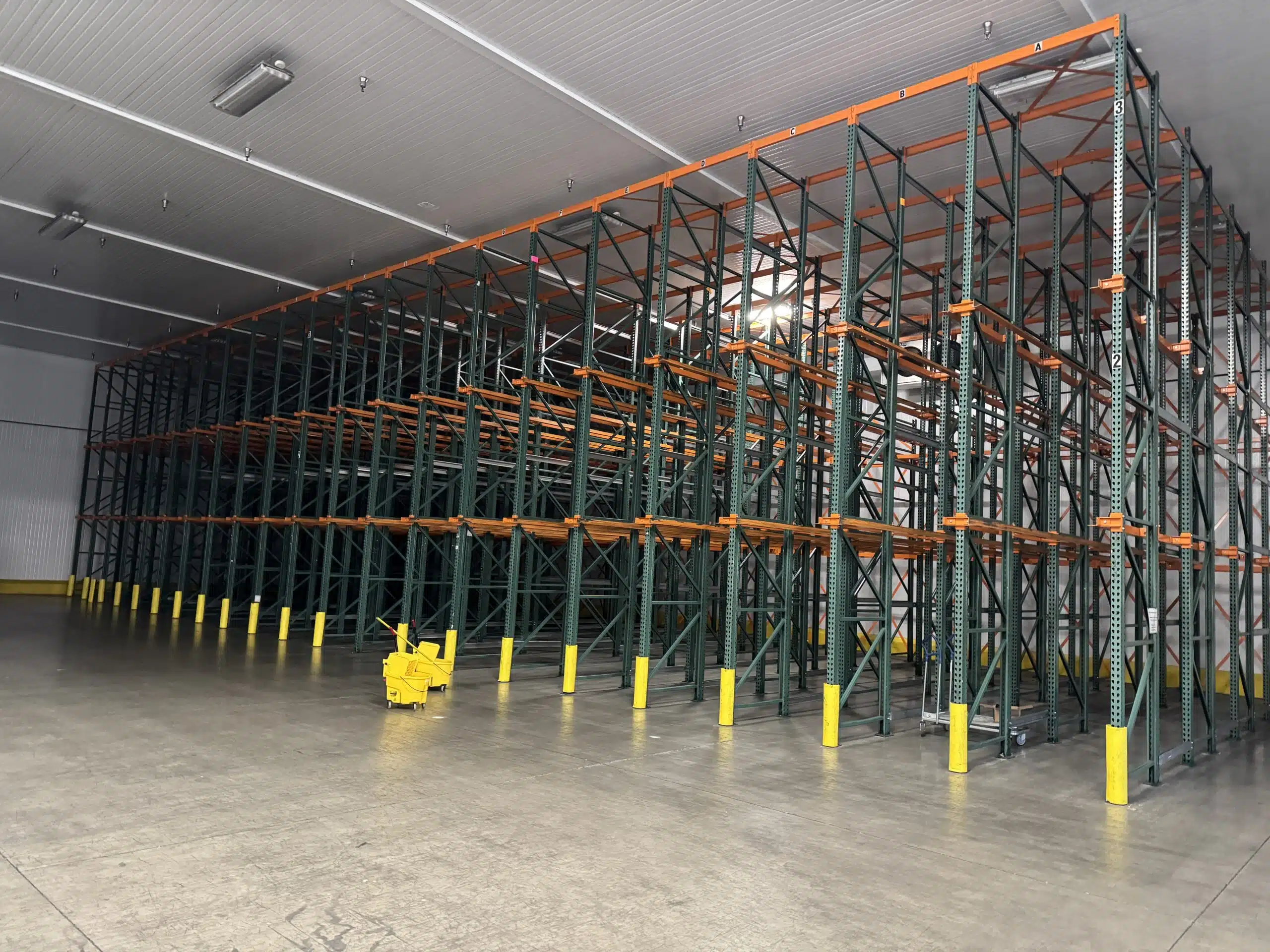
Drive-in rack is a high-density storage system that minimizes the number of aisles required by allowing lift trucks to enter the rack structure and then back out to load and retrieve pallets. This makes drive-in rack a LIFO option.
It can be particularly useful for operations with relatively few SKUs and large quantities of each SKU.
Because pallets are stored in deep lanes, drive-in is generally better suited to inventory profiles where high density is more important than direct access to every pallet position.
In this case study, learn how a tomato producer used a drive-in racking system in their cold storage section of their warehouse.
Drive-Through Rack
Drive-through rack allows material handling equipment to enter the rack from either side. This configuration can be useful when the storage operation benefits from access from both ends of a storage lane.
The appropriate configuration depends on product flow, inventory turnover, and the facility’s material handling process.

Carton Flow Rack
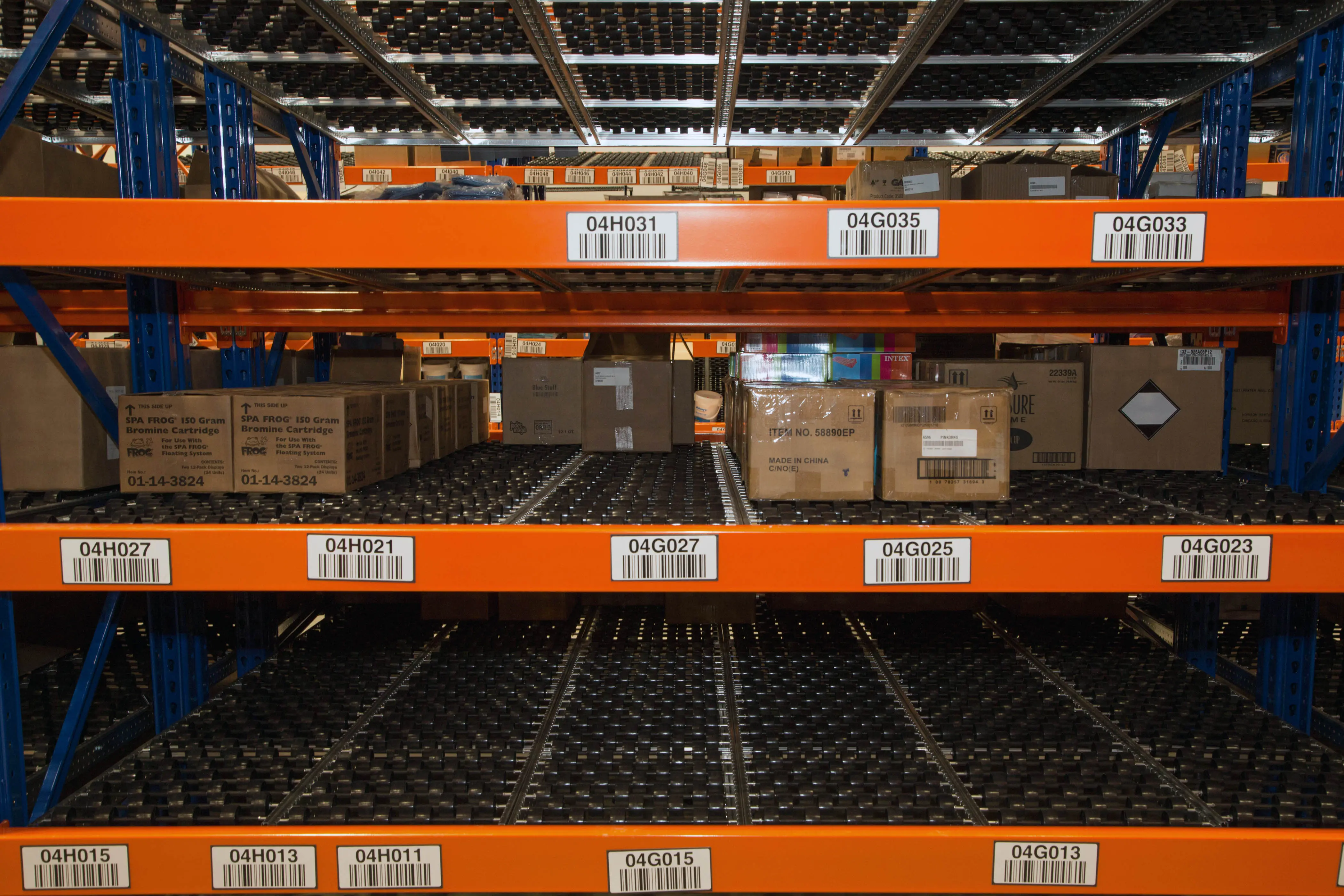
Carton flow rack is designed for FIFO storage of smaller individual cases or cartons rather than pallet storage. It can be used within cold storage operations where order picking is performed at the case level.
The appropriate rack system depends on the level at which inventory is stored and picked, as well as the volume and turnover of the products.
When Should You Consider a Rack Supported Cooler or Freezer?
For some operations, the most effective way to increase cold storage capacity is not simply to add conventional rack inside an existing building.
A rack supported cooler or freezer uses the rack structure itself to support the building enclosure and can be considered when a new temperature-controlled storage structure is being planned.
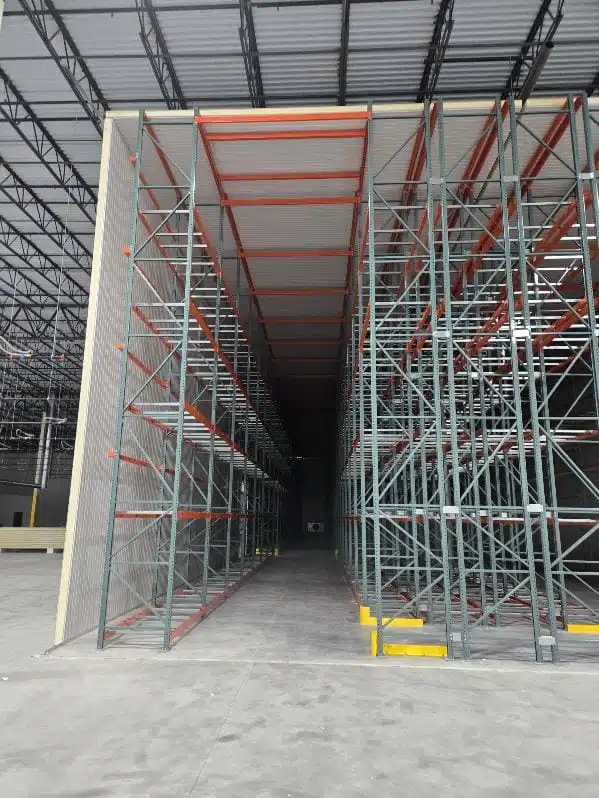
The appropriate approach depends on the operation’s:
- Storage volume
- SKU profile
- Required throughput
- Storage density
- Available building space
- Growth expectations
- MHE requirements
- Temperature-control requirements
In this case study, learn how a pallet rack supported freezer and a selective rack supported cooler was the ideal choice for a vaccine distributor’s operation.
When Is Automation the Right Choice?
Automation can be a good fit for cold storage operations that need high storage density, consistent throughput, or reduced reliance on operators working in low-temperature environments. For pallet storage, pallet shuttle systems can be particularly useful when an operation has many pallets per SKU and wants to store them deeply without requiring a forklift to enter every storage lane.
Pallet shuttle can also address certain operational challenges associated with conventional pallet flow or other rack systems. For example, REB is currently working with a customer that is evaluating a transition from pallet flow to pallet shuttle in its freezer. In addition to automating pallet movement within the lanes, the change could help address an issue the customer has experienced with pallet-flow wheels.
Temperature changes occur as pallets and material handling equipment move in and out of the freezer, creating conditions where moisture can melt and then refreeze around the pallet-flow wheels. This can interfere with pallet movement and create an ongoing operational challenge. A pallet shuttle system uses a powered shuttle to move pallets within the storage lane rather than relying on the same pallet-flow wheel arrangement, which can eliminate this particular source of freezing-related disruption.
Reducing forklift traffic within the rack system can also be a reason to consider automation. If an operation experiences frequent rack damage because material handling equipment is repeatedly contacting rack components, a pallet shuttle system can keep forklifts out of storage lanes and reduce opportunities for those impacts. This can help address a recurring rack-damage problem while also potentially improving throughput and reducing the need for rack repairs.
Automation should still be evaluated based on the entire operation rather than treated as a solution to a single problem. SKU count, pallets per SKU, throughput, storage density, labor availability, MHE requirements, rack damage history, and future growth all factor into whether pallet shuttle or another automated system makes sense.
Structural vs. Roll-Formed Rack for Cold Storage
Structural and roll-formed rack can both be used in cold storage. The decision should not be based on temperature alone.
Why Structural Rack Is Commonly Used
Structural steel rack is not necessarily required simply because a facility operates a cooler or freezer. However, it is often preferred in cold storage applications because of its added robustness where rack components are exposed to material handling equipment.
Working in a cold environment can contribute to operator fatigue, which may increase the potential for equipment to hit the rack. When rack components are regularly exposed to MHE, the greater impact resistance of structural rack can help reduce the potential for damage and the resulting need for repair or replacement.

Structural rack can also be advantageous in applications where sanitation and washdown are important. For certain food storage applications, applicable RMI or FDA requirements may influence the rack construction and design. Because requirements can vary by application, industry, and how the storage system is used, it is important to evaluate those requirements as part of the rack selection process.
Ultimately, the choice between structural and roll-formed rack should consider the application, MHE exposure, sanitation requirements, and other design factors, not simply the temperature of the storage environment.
When Roll-Formed Rack May Be Appropriate
Roll-formed rack may also be considered, particularly when cost is an important factor or when rack components are protected from direct MHE exposure.
For example, in some dense storage systems such as pallet flow and push back, internal components may be shielded from lift truck traffic. In those applications, not every component necessarily needs the same level of impact resistance.

The exposed portions of a system may still require more robust construction or protection, in which case those portions can be designed with structural rack while internal components can be designed with roll-formed rack.
The decision should therefore consider where the rack is exposed to equipment and what level of durability the application requires.
What Should You Consider About Pallets in a Freezer?
Pallet condition is an important consideration in cold storage, particularly when pallets will remain in the environment for extended periods.
Wood pallets are commonly used in cooler and freezer applications. The concern is not necessarily that wood pallets cannot be used in a freezer, but that poor-quality or damaged pallets can create problems.
Broken boards, cracks, splinters, and other damage can allow moisture to enter the pallet. When that moisture freezes and expands, it can contribute to further pallet deterioration.
A pallet that appears structurally adequate when it enters storage may become a problem if it remains in a cold, humid environment for an extended period.
Cold storage operators should therefore consider:
- Pallet quality and condition
- Pallet dimensions and construction
- How long pallets remain in the facility
- Whether pallets are repeatedly reused
- How damaged pallets are identified and removed
The pallet is part of the storage system. Its condition can affect how reliably pallets move through the rack and whether they can be safely stored in deeper-density systems.
Do Push Back or Pallet Flow Wheels Freeze in a Freezer?
Properly specified components should be designed for the environment in which they will operate.
For example, push back systems used in cold or humid environments should use appropriately protected, closed bearings. Pallet flow components should likewise be selected and tested for the intended temperature and operating conditions.
However, ice buildup around rollers or wheels can occur when the actual operating environment differs from the conditions for which the system was designed.
One example is a freezer where doors are not consistently closed. Warm, humid air can enter the freezer and create condensation and ice buildup around the equipment.
In that situation, the ice may be an operational or environmental issue rather than an indication that the rack components are inherently unsuitable for freezer temperatures.
This illustrates an important principle in cold storage: the rack system needs to be designed for the intended environment, but the operating practices also need to maintain that environment.
Other Cold Storage Design Considerations
Rack selection is only one part of designing a cold storage system. The rack must work within the larger facility and its refrigeration, building, and operating requirements.
Airflow and Refrigeration
Racking can affect airflow within a cooler or freezer, so rack layout should be coordinated with the facility’s HVAC and refrigeration design.
The storage system can change how air moves through the space, particularly as the facility moves from a partially loaded condition to a fully loaded one. A refrigeration system that provides adequate airflow when storage areas are relatively open may perform differently once pallets occupy the available storage positions. Rack height, aisle configuration, storage density, and the amount of open space around the racking can all affect how effectively conditioned air reaches the stored product.
Coil placement is another consideration. Depending on the storage system and facility design, refrigeration coils may be positioned above the racking or distributed within the storage area. Because cold air sinks, the available vertical space above the rack can be part of the refrigeration strategy. At the same time, maximizing storage cube may favor extending storage higher into the available space. The right balance depends on the required temperature, storage density, building configuration, and refrigeration design.
For this reason, the rack designer and HVAC/refrigeration professionals should coordinate their designs rather than treating the storage system and temperature-control system as separate projects.
Floor Slope and Drainage
Cold storage facilities may incorporate floor slopes and drainage systems to address water created through condensation or when a temperature-controlled space returns toward ambient conditions.
Existing drawings and field measurements can help identify floor conditions that need to be considered when laying out the rack system.
Workforce and Rack Protection
The people operating the storage system are another consideration.
A facility with an experienced, consistent workforce may approach rack protection differently than one that relies heavily on temporary labor during seasonal peaks.
How to Expand Your Cold Storage Space Now or in the Future
Running out of freezer space does not necessarily mean that a larger freezer is the answer. Before adding conditioned square footage, evaluate how the existing space is being used. A different storage system, denser rack configuration, revised aisle strategy, or better use of vertical cube may provide additional capacity without expanding the building.
Future growth should also be part of that evaluation. If demand is predictable, it may make sense to build the additional capacity into the initial cooler or freezer design. This can avoid the cost and complexity of modifying the system later. If future demand is less certain, designing around current requirements and planning for a later expansion may be more practical.
Expanding or reconfiguring a cold storage system later does not necessarily mean operations have to stop. However, working in a cooler or freezer can make rack installation, removal, or reconfiguration more time-consuming and costly because crews are working in a harsher environment. That potential future cost should be considered when deciding how much capacity to build today.
A rack supported cooler or freezer can provide another option for phased growth. For example, a facility can be designed around its current capacity and a second rack supported structure can be added alongside it when additional space is needed. Depending on the design, the structures can even be connected with a doorway, allowing the facility to expand while maintaining the existing operation.
Ultimately, the decision comes down to balancing the cost of investing in capacity today against the cost, timing, and operational impact of expanding later. Because unused freezer space still costs money to condition, the goal is not necessarily to build as much capacity as possible, but to plan the storage system and facility around realistic current and future needs.
Rack Safety in Cold Storage
Rack safety is important in any warehouse, but coolers and freezers introduce environmental and operational conditions that can make rack inspections and damage management more challenging.
Why Cold Storage May Require More Frequent Rack Inspections
Cold storage environments can introduce factors that are not typically present in ambient warehouses. Frost and ice can build up on rack components, potentially affecting the plumbness of frames and the condition of connections and anchors. Temperature changes can also cause components to contract and expand, making it important to monitor connections and anchor torque over time.
Moisture and temperature fluctuations can also contribute to corrosion when rack components or anchors are not appropriately protected for the environment.
Cold storage conditions can also increase the potential for rack impacts during normal operations. Employees working in coolers and freezers may wear bulky PPE, goggles, or other protective equipment that can limit visibility and awareness of their surroundings. Slick floors and the physical demands of working in cold temperatures can add to the challenge. These factors can increase the likelihood of material handling equipment contacting rack components, making rack protection and regular inspections particularly important.
Rack Protection for Coolers and Freezers
The cold storage environment should also be considered when selecting rack protection. Galvanized steel protection is often a good choice for deep freezer applications because some plastics can become brittle when exposed to consistently low temperatures.
However, not all plastic protection performs the same way. Some products have been specifically tested and rated for freezer applications and can perform well in those environments. The important consideration is to verify that the specific protection product is designed and rated for the temperatures and conditions where it will be used.
Common Types of Rack Damage in Cold Storage
Rack damage in cold storage commonly involves beams and frames being struck by material handling equipment. Deep-lane systems such as drive-in and drive-through rack can be particularly susceptible because equipment operates within the rack structure.
For example, an REB rack safety specialist encountered a cooler with drive-in rack on both sides of the aisles where virtually every upright had required a repair kit due to repeated impacts. Situations like this can indicate a recurring operational problem rather than an isolated incident and may warrant evaluating rack protection, MHE practices, operator training, or even whether the storage system is appropriate for the way the facility operates.
What to Do When Rack Damage Is Found
If rack damage is discovered in a cooler or freezer, the response should be similar to an ambient warehouse: if the damage presents a significant safety concern, restrict access to the affected location and have the damage evaluated by a qualified rack safety professional.
The severity and location of the damage matter. A damaged beam may be addressed by restricting access to the affected area while the condition is evaluated. Damage to an upright can have more significant consequences because uprights are part of the rack’s structural system.
Rack supported structures require additional consideration. In these systems, the rack is part of the building’s structural system, so significant damage to an upright or other structural rack component could have implications beyond the storage rack itself. The appropriate response depends on the severity and location of the damage, but personnel should not assume that normal warehouse procedures are sufficient when structural components of a rack supported building are involved.
In this case study, learn how a food and beverage company address damaged racking in their freezer.
How REB Can Help with Cold Storage Racking
The goal of a cold storage material handling system is not simply to fit more pallets into a cooler or freezer. It is to develop a storage system that uses conditioned space effectively while supporting the way the operation actually stores, retrieves, and moves its products.
REB Storage Systems can help evaluate these factors and develop a storage solution based on the specific requirements of the operation. Our experience includes cold storage applications ranging from conventional pallet racking to high-density storage systems and rack-supported coolers and freezers.
Contact a REB expert to begin understanding your best options for your cold storage operation by calling (800) 252-5955 or fill out the contact form on this page.
Frequently Asked Questions about Cold Storage Systems
The following questions address common cold storage racking considerations based on REB’s experience designing and implementing storage systems for cooler and freezer environments.
What type of racking is best for cold storage?
There is no single rack system that is best for every cold storage application. The appropriate system depends on factors including SKU count, volume per SKU, FIFO or LIFO requirements, product turnover, desired storage density, MHE, and available space.
Is structural rack required for freezer storage?
No. Freezer temperature alone does not automatically require structural rack. Structural rack is often preferred in applications where rack components are exposed to material handling equipment and therefore impact, while roll-formed rack may be appropriate in some applications depending on the system design and level of exposure.
Can wooden pallets be used in a freezer?
Yes. Wooden pallets are commonly used in cold storage. Pallet quality and condition are important considerations, however, because damaged or moisture-affected pallets can deteriorate over time and create problems within the storage system.
Do pallet flow or push back rack wheels freeze in a freezer?
Properly specified components should be designed for the intended cold storage environment. Ice buildup can nevertheless occur when warm, humid air enters the freezer, particularly around doors that are not consistently closed. This can create operational issues even when the rack components themselves are appropriate for the temperature. This makes ensuring that the environment does not change due to operational inefficiencies that the rack system was not intended for.
Should I maximize every cubic foot of my cooler or freezer?
Not necessarily. While maximizing storage density can reduce the amount of conditioned space needed, filling every available cubic foot with storage is not always the best operational strategy.
For example, REB worked with a floral distributor whose climate-controlled warehouses were not completely racked. During busy periods, the operation needed open floor space to stage carts, while the unracked space also provided room for future expansion. In this case, leaving some space available supported the operation and provided flexibility as the business grew.
What should I consider before investing in cold storage racking?
Before selecting a rack system, understand your inventory profile, how products move through the facility, the MHE that will be used, available vertical and horizontal space, refrigeration and airflow requirements, pallet characteristics, and expected future growth.
How can I get more storage capacity without building a larger freezer?
First determine whether the existing space is being used efficiently. A different rack configuration, greater storage density, reduced aisle space, improved use of vertical cube, or a combination of these approaches may increase capacity without increasing the conditioned footprint.
Article Author: Philip Nelson
Article Contributor: Mike McCue
Share this post:
Submit Your Inquiry
Since 1962
REB has completed more than 100,000 projects in 15 countries (including all 50 states) for more than 20,000 customers across 50 industries, with 70% of customers as repeat buyers.
This is made possible by our team that has more than 300 years of industry experience designing and project managing material handling systems.
Learn more about REB's award winning service.